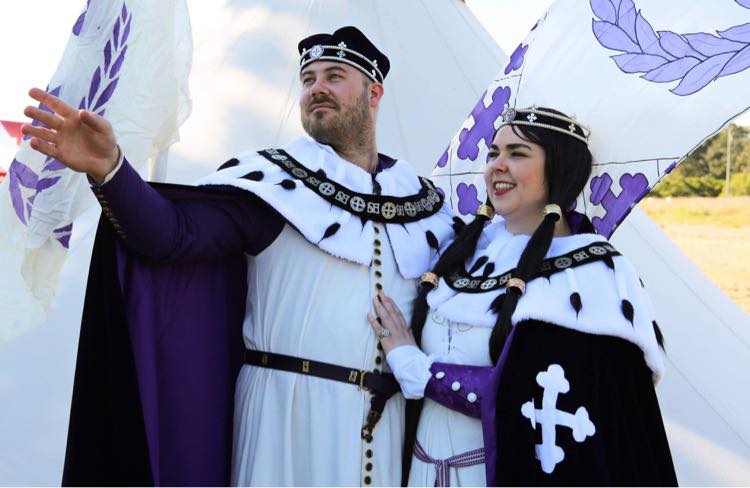
Men’s clothing in the 13th Century
By Meroë M. Cahill (Rohese de Fairhurst)
Introduction
When I started in the SCA, clothing of the 13th century was referred to as 'sacks', and was rarely worn except when you needed to whip up a tunic in 2 hours and had no sewing skills to make anything more complicated than a 'sack'! However, the last few years has seen some people discovering the elegant lines of the deceptively simple 13th century garments, and the gracefulness of these clothes.
Although the focus of this article is on 13th century clothing, it will include some examples from the early 14th century, as there is a gradual change in style.
Richer people wore clothes made from finer quality fabrics or from imported fabrics. They were likely to wear clothes dyed with expensive dyestuffs, such as crimson, black or purple. People further down the social scale wore paler clothes, which was either because they were faded, dyed from the dregs of batches of dyestuffs, or dyed using inferior dyestuffs. By the 14th century, servants often wore striped materials because of their ease of manufacture. However, striped fabrics made by sewing woven ribbons onto fabric were worn by nobility and royalty, as ribbons were expensive and time-consuming to produce. Fur-lined garments were also a marker of social status, although impractical for us due to the heat.
Select a fabric which is made of natural fibres. There are many examples of linen underdresses in contempory accounts, although few examples of linen clothing survive due to the breakdown of plant fibres when buried. Many of the surviving materials are made of wool or silk. These fabrics may be plain, or woven in a textured pattern, or woven as a damask. Extant examples have stripes woven into the material. Brocades were favoured by the upper class, although it is difficult to find brocades with suitable patterns nowadays for a reasonable price. Textured materials were also extremely popular, especially material woven in a diamond pattern (‘diapering’).
Within the SCA, tunics are generally cut out by laying a shirt upon a piece of material folded into quarters and drawing around the shirt and extending the pattern to the desired length. However, there are no existing garments which were made using this style of pattern. This pattern is wasteful of material and requires wider materials than those generally produced in the Middle Ages. However, I feel that the main argument against using this pattern is that clothes cut in this manner hang differently and look different to clothes cut using period cutting methods. During this time period, tunics were made from rectangles and triangles of fabric (see Figure 1 for an example of the cut of a surviving tunic). This method involves several more seams, but is a very economical use of fabric.

Figure 1
Although we can learn much by examining the cut of surviving garments, it should be remembered that only a tiny fraction of garments survived, and that these garments may not be representative.
The 13th century saw loose flowing gowns. Women’s gowns are often puddled around their feet in pictures. A common feature for both sexes are sleeves which are relatively loose and baggy above the elbow but more fitted below.
During the 13th century we see the introduction of buttons. Crowfoot has an example of part of a sleeve from the 2nd quarter of the 14th century, which has buttonholes on both sides of the slit cuff. Shanked buttons were inserted through buttonholes on both sides of the slit, and a cord was passed through the shank of the buttons, securing the sleeve closed. Small, rounded metal buttons with a shank are best if you can find them, or cloth buttons can be made from matching material scraps.
Male Dress in the 13th Century
Tunics- Tunics had sleeves which were tight over the lower arm, but were quite loose and bloused over the upper arm. This can be produced by either cutting the sleeve in several parts (a baggier upper sleeve attached to a tapering lower sleeve) or by adding a large diamond-shaped gusset under the armpit .The tunics were loose in the body, and often belted loosely below the waist.
Men's tunics sometimes had a slit up the centre front and back (for riding horses), or up the sides. Tunics could be made of patterned material, especially damasks or with horizontal stripes (often seen in pictures of royalty or biblical figures)
.
Figure 2
Surcoats- Men often wore loose unfitted sleeveless surcoats over their tunics. Men's surcoats sometimes had a diagonal slit opening at the neck (Figure 2). The figure of the musician in Figure 3 is wearing a surcoat which is particoloured, and has long dags around the hem. Surcoats were worn quite long- below knee level
.
Figure 3
The gardecope (a loose overgarment with attached hanging sleeves) was often worn outside, particularly by people such as travellers. Figure 4 shows men wearing gardecopes with long tubular sleeves, with an opening near the top of the sleeve for the arm, while Figure 5 shows a man wearing a gardecope with small, almost vestigial, sleeves, and slits up the sides which could be closed with buttons,

Figure
4
Figure 5
Hose- Men wore hose made from a woven material which was cut on the bias (the stretchy diagonal direction on woven material), worn over loose linen underdrawers. Examples of hose are sometimes footless, or look like stirrup pants, although some hose have sewn in feet. The hose are tied to the front of a belt, or the string holding up the man's underdrawers. Underdrawers were loose linen pants, rolled over a string which held them up at the waist (Figures 6 & 7).

Figures 6 and 7
Headwear- Men often wore a fitted linen coif, with strings tying under the chin. Hoods were also very popular. Men also wore straw hats, especially farm workers and outdoor trades. The straw hat was often worn over the linen coif (Figure 8). In Spain, men also wore the pillbox type hat.

Figure 8
Accessories- belts were 1-1 1/2 inches wide, and had decorated belt buckles and belt caps. Sometimes the belt itself was decorated. Belts were worn buckled (without the knot so commonly seen on SCAers), and with the tongue hanging down to about the level of the knee.
The angels in Figure 9 are both wearing pouches with a shoulder strap, worn diagonally across the body. Travellers or pilgrims would have probably worn this style.

Cloaks- Cloaks were usually made from a semicircle of woollen material, and were sometimes lined with a contrasting material or fur. Cloaks were usually held on with a pin or brooch or with a double cord wrapped around two brooches (fancy buttons would be a cheaper alternative). In Figure10, the old man is wearing a rectangular or semicircular cloak roughly pinned to form a hood
.
References
‘Bockstensmannen och hans drakt’ by Margareta Nockert. 1980.
‘Book of Costume’ by Millia Davenport.
‘Fashion in the Age of the Black Prince’ by Stella Mary Newton. Published by The Boydell Press, Suffolk, 1980.
‘A History of Illuminated Manuscripts’ by Christopher de Hamel. Published by Phaidon, London, 1994.
‘The Illuminated Manuscript’ by Janet Backhouse. Published by Phaidon, Oxford, 1979.
"Illuminated Manuscripts. The Book before Gutenberg’ by Giulia Bologna. Published by Thames & Hudson, London, 1988.
‘Textiles and Clothing c.1150-c.1450’ by Elisabeth Crowfoot, Frances Pritchard & Kat Staniland. Published by HMSO, London.